Why 2026 is the Agent deployment year / Three selection questions / Personal assistants & Gateway / Frameworks & Harnesses / Browser automation / Model infrastructure / Decision matrix / Deployment pitfalls
If you've been following the tech scene in the first half of 2026, you've probably seen the same pattern repeat: an AI Agent repo gains tens of thousands of stars in days, someone in a forum is already controlling their machine via Telegram, and someone else just wiped their system after a "one-click install" gone wrong. GitHub's AI-related repositories have surpassed four million, yet the ones actually worth pulling down and deploying today aren't simply the top-ten by star count. The real question is whether you need a personal digital employee or an auditable production orchestration system, and how much system access you're willing to hand to a model.
This roundup is not sorted by hype. It's organized by deployment scenario—from Gateway-style personal assistants like OpenClaw, to production-grade Harnesses like LangGraph and DeepAgents, to Webwright's long browser tasks and Dify/n8n's low-code orchestration. For each layer, I'll explain what you get by deploying now, what's still missing, and how to pair it with a cloud Mac node for stability.
Why 2026 Is the Agent "Deployment Year"
The past two years were mostly about "is the model smart enough?" In 2026, the debate has shifted to "can the model keep working?": multi-step tool calls, cross-session memory, human-in-the-loop approval, failure recovery—these were just demos in the GPT-4 era, but now they're hard selection criteria. At the same time, MCP (Model Context Protocol) has turned "connecting tools to Agents" from proprietary plugins into interchangeable interfaces. OpenClaw, Cursor, Claude Code, and others are aligned on the same protocol, and the deployment barrier is visibly lower.
Another shift: "local-first" and "cloud orchestration" are no longer opposites. Individual users want their data and Shell on local machines; teams need to embed Agents into CI, ticketing, and internal APIs. Within the same open-source stack, you can run Ollama on a Mac mini for a lightweight 7B model assistant, or use LangGraph Platform to host checkpointed long-tasks on a server. Behind the star spikes is deployment path divergence: some are chasing viral personal assistants, others are adding production observability.
Technical Layer Overview
Define the Layer Before Selecting
The 2026 AI Agent ecosystem roughly divides into four layers:
Layer-to-Project Mapping
| Layer | Representative Projects | What It Solves |
|---|---|---|
| Personal Gateway | OpenClaw, LobsterAI | Message entry and personal execution |
| Dev Framework | LangGraph, CrewAI | Task orchestration and state management |
| Scenario Specialist | Webwright, n8n | Browser/workflow automation |
| Model Infrastructure | Ollama, Open WebUI | Local inference and tool protocol |
The old approach of writing a custom adapter for every integration has been replaced by MCP tool discovery—the Host automatically fetches the Server's tools/list on startup, with no need to write bespoke clients per integration.
Three Questions Before Deploying
These three questions will filter out 80% of "looks hot but wrong for me" repos:
- Permission boundaries—Does the Agent need full Shell, filesystem, and browser access? Fine for personal experiments; production must separate roles and add approval steps.
- State and recovery—Will tasks run for more than 30 minutes? Is crash-then-resume from a checkpoint required? If yes, choose LangGraph-style explicit state machines, not a single-pass ReAct loop.
- Integration surface—Are you connecting to Lark/WeChat/Telegram, or to internal Git, Jira, and databases? Gateway projects (OpenClaw) win on channels; framework projects (CrewAI) win on role delegation; low-code (Dify, n8n) wins on visual ops panels.
Design principle: First think through "who uses it, where, and who's accountable when it breaks," then look at star counts. Stars reflect attention and community momentum, not production readiness.
Personal Assistants & Gateway Layer: Usable Now, But Manage Permissions
OpenClaw: The Breakout Gateway for "One Machine, One Assistant"
OpenClaw is one of the most-discussed Agent projects on GitHub in 2026. Core value: local Gateway + multi-channel messaging—you send commands in Telegram, Slack, or Discord; the Agent runs Shell, reads/writes files, and calls MCP tools on your machine. Reasons to deploy now: Out-of-the-box multi-channel support, active community Skill ecosystem, model-agnostic (OpenAI, Anthropic, local Ollama). If you already have a persistent Mac or Linux host, you can wire up "phone message → local folder organizer" in a weekend. Reasons to delay company-wide rollout: Default permission scope is large; you'll need to handle network isolation, Skill source auditing, and key management yourself. Better suited to a technical lead's personal experiments or a small-team intranet sandbox than an unfortified public-facing deployment.Basic OpenClaw startup commands:
# Install OpenClaw (requires Node.js 18+)
npm install -g openclaw
openclaw start --port 3000
ssh -R 3000:localhost:3000 user@cloud-mac.zekvps.com
Press Ctrl + C to terminate the local process; on remote nodes, use launchd to manage process lifecycle so the Gateway stays up when the session drops.
Dev Frameworks & Harnesses: Prioritize This Layer for Production
LangGraph: Explicit State Machine—the Default for Long Tasks and HITL
LangGraph is not another Chat wrapper. It's a stateful, persistent, branching orchestration runtime. Teams like Klarna and Replit use it for long-horizon Agent workflows: checkpoints let tasks resume after process crashes; conditional edges make "approve/reject" a hop in the graph rather than hardcoded if-else.Framework Core Concepts Compared
| Framework | State Model | Learning Curve | Production Readiness |
|---|---|---|---|
| LangGraph | Explicit state machine | High | ⭐⭐⭐⭐⭐ |
| DeepAgents | LangGraph preset | Medium | ⭐⭐⭐⭐ |
| CrewAI | Role config | Low | ⭐⭐⭐ |
| Dify | Visual workflow | Very low | ⭐⭐⭐⭐ |
Framework Terminology Quick Reference
- Checkpoint
- LangGraph persists state after each node execution. After a process crash, tasks resume from the latest checkpoint—no full restart needed for long workflows.
- HITL (Human In The Loop)
- Embeds human approval into key Agent decision nodes rather than letting the model run fully autonomously.
- Harness
- A wrapper above a framework that pre-wires planning, delegation, and context-management middleware so teams can ship faster without building from scratch.
- ReAct Loop
- Reason + Act single-pass loop—fine for simple tool calls, but not suited for complex tasks requiring cross-step memory.
Deep dive: Why is LangGraph better than ReAct for long tasks?
The problem with ReAct is that state only persists within a single conversation turn. If a task needs 30 minutes and multiple tool calls, any interruption loses all progress. LangGraph's checkpoint mechanism writes each step's state to persistent storage (SQLite, PostgreSQL, or Redis), so after a restart the task continues from the breakpoint.
More importantly, LangGraph makes "human approval" an ordinary node in the graph: the workflow pauses at an approval node, waits for human input, then either continues or branches to a revision path on rejection. This is architecturally impossible with a single-pass ReAct loop.
Scenario Specialists: Browser Automation & Workflow Orchestration
Webwright: Microsoft's Browser Agent Framework
Webwright, publicly released in April 2026, brings SWE-style thinking to the browser: it gives the model a terminal + Playwright session and completes long web tasks using code actions rather than pure coordinate-clicking, then crystallizes solutions into reusable Skills (Skill Factory).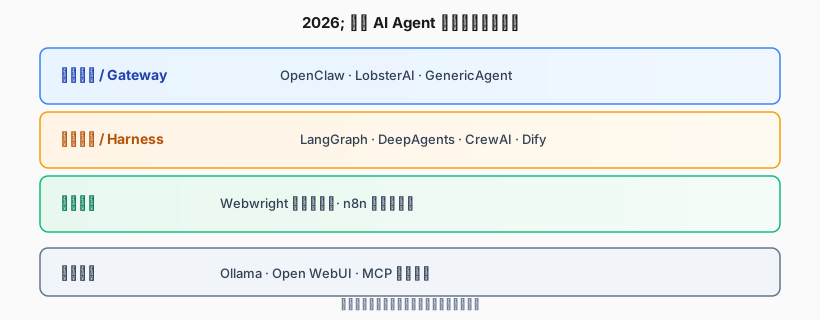
Model & Tool Infrastructure: What Agents Run On
Every Agent, no matter how sophisticated, depends on two things: model inference and tool protocol.
- Ollama—pull models locally, unified API, excellent experience on Mac Apple Silicon, suitable for offline or hybrid routing with OpenClaw / Open WebUI.
- Open WebUI—self-hosted Chat frontend + plugins, suited for a shared internal intranet entry with MCP or function tools attached.
- MCP ecosystem—databases, Git, browser, Office tools are progressively adopting MCP; checking the official support list beats trusting "supports 1000+ integrations" marketing.
Running 8B–14B models for tool calls on Apple Silicon Mac, unified memory architecture is often less stressful than a same-price PC. If you need to run Xcode builds alongside Agent experiments, consider splitting inference and builds across separate cloud Mac nodes to avoid peak memory contention.
Decision Matrix: Deploy Now or Wait?
| Project | Best For | Deploy Now? | Main Risk |
|---|---|---|---|
| OpenClaw | Personal/small-team Gateway, multi-IM control | ✅ Experiment / intranet pilot | Large permission scope, Skill supply chain |
| LobsterAI | Chinese office + IM integration | ✅ Office automation | Desktop dependencies, model cost |
| LangGraph | Long tasks, checkpoints, human approval | ✅ Production core orchestration | Learning curve, needs own observability |
| DeepAgents | Quick LangGraph-based Harness | ✅ Internal tool MVP | Tracks LangChain version changes |
| CrewAI | Role-based multi-Agent prototype | ✅ Demo; ⚠️ core compliance flows | Complex state needs LangGraph |
| Dify | Low-code RAG + Agent panel | ✅ Business-participable scenarios | Deep custom needs code export |
| Webwright | Long web tasks, no-API backends | ✅ Isolated-environment PoC | Browser credentials, anti-scraping |
| GenericAgent | Learning / building your own Agent base | ✅ R&D experimentation | Must add gateway and audit yourself |
Four Deployment Pitfalls Not to Ignore
- Keys leaking into Prompt logs—API Keys and Cookies can end up in LangSmith / local debug logs. Use secret injection + log scrubbing; never hardcode in Skills.
- Public Gateway—OpenClaw-style services mapped directly to the public internet without auth are discovered by scanners within hours. Prefer Tailscale / intranet + reverse proxy with auth.
- Runaway model costs—Long web tasks + multi-round reflection can burn hundreds of dollars in API bills overnight. Set budgets, step limits, and concurrency caps on sub-Agents.
- No rollback path—Agent file edits and directory deletions are irreversible. Use Git workspaces, snapshot disks, or a dedicated cloud Mac instance for "dirty work" environments—don't let your primary machine be the sole execution surface.
See the site's OpenClaw column for orchestration and Mac node pairing practices.
Give Your Agent a Clean 'Execution Lane' with a Cloud Mac mini
Dedicated M4 node, rent by the day, SSH ready out of the box
Singapore · Japan · Korea · Hong Kong · US nodes available
If you are moving MCP or Agents from demo to daily use, a snapshot-ready cloud Mac node beats swapping frameworks again. View ZekVPS cloud Mac mini plans — Separate lab from daily driver for calmer deployments.