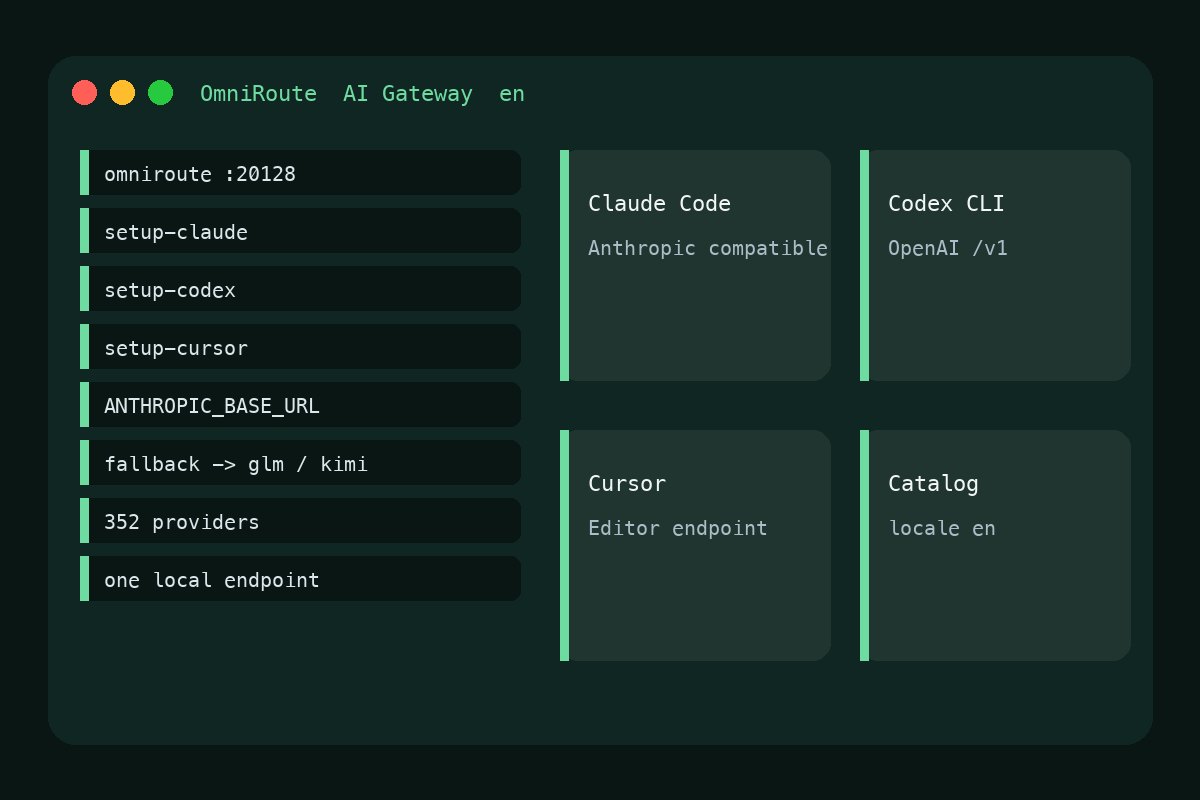
When Claude Code, Codex, and Cursor are open in the same week, the bottleneck is rarely “find a stronger model.” It is three keys, three base URLs, and three improvised fixes after a quota dies. OmniRoute is useful when it collapses those entry points into one local AI Gateway, then lets you decide which models deserve a daily profile.
Data point: OmniRoute v3.8.50 publicly lists 352 providers and about 1,312 unique chat model IDs. That is not “exactly 352 models.” The number in headlines is the access surface. The acceptance test is whether one endpoint can serve Claude Code, Codex, and Cursor without a new environment file every afternoon. (GitHub: OmniRoute)
Verdict: unify the entrance first, count models later. If you already jump between three coding agents and their env vars, spend 30 minutes on OmniRoute. If you have one official plan and almost no quota stops, do not add a gateway just because a chart says 352.
This guide is for solo developers who keep Claude Code and Cursor open together, small teams that want Codex CLI and the editor on one token, and leads who would rather park a gateway on a cloud Mac than rebuild it on every laptop.
Last updated 11 September 2026. Treat catalog sizes as the project’s public figures that day; confirm with a live /v1/models call before you write them into an internal wiki.
What 352 actually means
Search snippets collapse “352 providers” into “352 models.” The safer reading, from the README and omniroute.online, is:
- 352 is the registered provider count; roughly 150 carry a free-discovery flag.
- The chat catalog is 1,200+ model IDs (about 1,312 around v3.8.50).
- Free budgets, OAuth lanes, local models, and cloud catalogs use different denominators. Do not add them into a sales number.
That changes the procurement question. You are not buying 352 models. You are asking whether one OpenAI-compatible entrance can point Claude Code, Codex, and Cursor at the same machine; whether quota exhaustion triggers fallback; and whether logs tell you if a failure was a key, a model id, or the tool’s own protocol.
OmniRoute is a self-hosted MIT AI gateway. The default local port is 20128. Coding tools send traffic to localhost; the gateway routes by catalog, quota, and fallback. The public site compares it with other routers on provider count, fallback policy, token compression, and one-shot CLI setup — not on a new chat UI.
Treat the catalog as a shelf and the gateway as a warehouse clerk. The shelf can be long; the clerk ships only a few lanes each day. 352 describes shelf width. Your daily profile describes shipping rules. Teams that invert those two ideas celebrate “we can reach many models” and still lack an operable coding workflow.
Why Claude Code, Codex, and Cursor need one gateway
- Protocols differ. Claude Code speaks Anthropic Messages; Codex speaks OpenAI Chat Completions; Cursor wants an OpenAI-compatible URL. Without a gateway you keep three mental models.
- Keys scatter. Anthropic in Claude Code, OpenAI in Codex, a third aggregator in Cursor. Rotation and offboarding become guesswork.
- Quotas do not sync. Claude stops; Cursor still hits the official API. Codex’s free pool ends; the editor never hears about it.
- Names do not reuse. The same DeepSeek or GLM can have three IDs. You cannot tell if a quality gap is the model or the spelling.
A gateway will not merge the three products. It will merge “which env var do I edit.” For a small team that is closer to daily work than another aggregator website.
If you also need MCP and tool servers on the same host, keep the lanes separate. The in-site note on deploying an MCP server on a cloud Mac mini is the tool path; OmniRoute is the model path. Do not debug both inside one process.
We also ask whether the three tools share a failure language. If Claude Code times out, Codex returns 429, and Cursor shows only “provider error,” while the gateway log has no common provider name or model id, the hop added almost no operational value. Unified calling is not three identical UIs. It is one person explaining one failure from one log.
How the three tools join one entrance
Official docs ship omniroute setup-* commands that read the live catalog and write each tool’s own config. (CLI Integrations)
| Tool | Command | Writes | Common miss |
|---|---|---|---|
| Claude Code | omniroute setup-claude | ~/.claude/profiles/…/settings.json | Do not put /v1 on ANTHROPIC_BASE_URL; the CLI appends /v1/messages |
| Codex CLI | omniroute setup-codex | ~/.codex/.config.toml | Use the OpenAI-compatible /v1 path and switch with profiles |
| Cursor | omniroute setup-cursor | Prints in-app steps only | Cursor stores settings opaquely; follow the printed Base URL and key fields |
For a demo, omniroute run claude or omniroute run codex injects env for one process. That is fine for a screenshot, not for a shared workstation.
Claude Code still filters the native /model picker to ids that start with claude or anthropic when gateway discovery is on. Kimi, GLM, and DeepSeek still route through a profile or ANTHROPIC_MODEL; they simply stay off that picker. (Claude Code configuration)
Passing acceptance means all three tools show up in the OmniRoute console, a failure names a provider, and you can change models without opening three vendor dashboards.
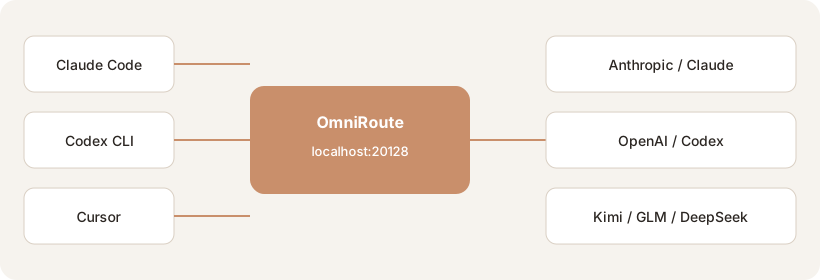
On the first wire-up, split “it chats” from “it can be daily.” A reply only proves the port is open. Daily use requires the same short task to reproduce in all three tools, a failure to map to a model id in the gateway log, and a profile switch that does not require three GUI tours. Teams often declare victory at the first reply, then discover Cursor is still on the vendor API, Claude Code has an extra /v1, or the Codex profile only lives in one terminal tab.
A 30-minute acceptance list
- [ ] Node.js is installed and
omnirouteruns on the Mac you will keep online. - [ ]
http://localhost:20128shows a catalog, not a blank page. - [ ]
/v1/modelswith the gateway key returns a live count. Do not paste the marketing number. - [ ] Wire one tool first — Claude Code or Codex — not all three.
- [ ] Send one short, repeatable task and read the log for model id, latency, and error class.
- [ ] Disable the preferred model and watch whether fallback fires.
- [ ] Attach the second tool and confirm it sees the same catalog, not a private alias list.
- [ ] Keep vendor keys on the gateway. Tools should hold only the gateway token.
If the catalog never loads, 352 is a poster. If the catalog is huge but fallback never runs, you added a proxy and a single point of failure.
Pin the short task. “List the test files in this folder and explain one function” is enough. Open-ended chat is a weak acceptance test: it will not show a wrong model id, and it will not show whether tool calls took the lane you think they took. Keep a row with time, tool, model id, fallback yes/no, and the raw error. Two weeks later that table tells you whether an upgrade broke the gateway or a free provider simply vanished.
When to adopt, when to skip
| Situation | Better move | Why |
|---|---|---|
| One person, one official plan, rare switches | Stay direct | A gateway adds a process, upgrades, and another log |
| Claude Code and Cursor fight over different keys | Adopt OmniRoute | Unify the entrance before arguing about the default model |
| Free pool for drafts, paid model for finals | Adopt, and write the route | This is where quota-aware scheduling earns its keep |
| Requests must stay on a named vendor or region | Check the provider, then decide | A large catalog is not a compliance list |
| LiteLLM already unifies the three tools | Do not migrate for a number | The cost is policy, not the install command |
Token compression (the project cites about 15–95% savings) is not a default money printer. It helps long repos and repeated context; it can add a transform on short completions. Toggle it on one task and compare quality plus the bill.
Routing does not fix broken tool-calling JSON. If agents fail on arguments, read why AI agents depend on JSON before you add another hop.
There is also an unglamorous reason to skip: nobody is on call. The gateway becomes a new single point of failure. A closed laptop, a crashed process, an expired cert, or a catalog API change can stop all three coding tools at once. If you cannot give that machine a restart policy and a snapshot, the convenience of one entrance will be erased by one shared outage. Staff the box, then talk about 352.
Why teams park the gateway on a cloud Mac
A laptop gateway is fine for one person. The moment Cursor, Claude Code, and a CI host share a catalog, the service disappears when the lid closes. A cloud Mac that stays up, snapshots cleanly, and can revoke access is the better home:
- Run the process under launchd or an equivalent supervisor.
- Expose 20128 only on a tunnel or a private net. Do not publish the console.
- Keep keys on the machine, out of git and chat logs.
- Snapshot before upgrades so a catalog change can roll back.
The Mac is not “a more expensive model.” It is the meeting point the three tools can keep using after a notebook sleeps. Review access split on the ZekVPS Mac support page; the gateway account should not be the host administrator.
For two or more people we prefer one gateway host plus each person’s editor, not one gateway per laptop. The second pattern looks more isolated and then copies routing rules, free-tier logic, and upgrades three times. The cost of a shared gateway is a tighter boundary: colleagues get a gateway token, not upstream vendor keys, and they cannot edit production routes. Once that line is written down, 352 providers stop being 352 ways to misclick.
FAQ
Does OmniRoute already ship 352 models?
As of September 2026, 352 is the provider count. The model catalog is over 1,200 IDs. Trust /v1/models on your host.
Can the three tools share one Base URL?
They can share one OmniRoute host, not one suffix. Claude Code usually omits /v1. Codex and most OpenAI-compatible clients use /v1. Cursor follows the printed setup-cursor fields.
Can I daily-drive free providers only?
They are fine for drafts. Do not make them the only path for client code or anything you must defend later. Free pools throttle, queue, and vanish.
Does this send every request to 352 vendors?
The gateway runs on a machine you control. You choose the upstreams. Unifying keys is not the same as opening every catalog row. Production routes should be a whitelist.
We already use OpenRouter or LiteLLM. Should we switch?
Not for the number 352. Switch if you still maintain three native configs and want setup-claude, setup-codex, and setup-cursor to finish the wiring.
Unify the entrance, then expand the catalog
OmniRoute is not a weekend contest to try 1,300 models. It is a way to stop rotating three almost-expired keys, to fail over instead of stopping work, and to compare models on one log. 352 describes width, not your default profile.
Once a personal trial works, move the gateway to a snapshot-ready cloud Mac so other editors can point at the same entrance. Compare host boundaries on the ZekVPS service page before you decide laptop versus remote node.
Close it with a line that can go in a weekly note: prove that three coding tools can hit the same local port, then decide which models enter the whitelist. The catalog can keep growing. The daily workflow should get shorter, swappable, and reversible.
Need one always-on gateway for three coding tools?
Close the laptop and the gateway vanishes. A cloud Mac stays up, snapshots before upgrades, and lets three editors hit the same entrance.
Monthly dedicated Mac mini rental keeps OmniRoute, logs, and key boundaries on a machine you can revoke — not copied onto every notebook.
After a personal trial works, moving the entrance to a snapshot-ready node beats buying another aggregator tab. View ZekVPS cloud Mac mini plans