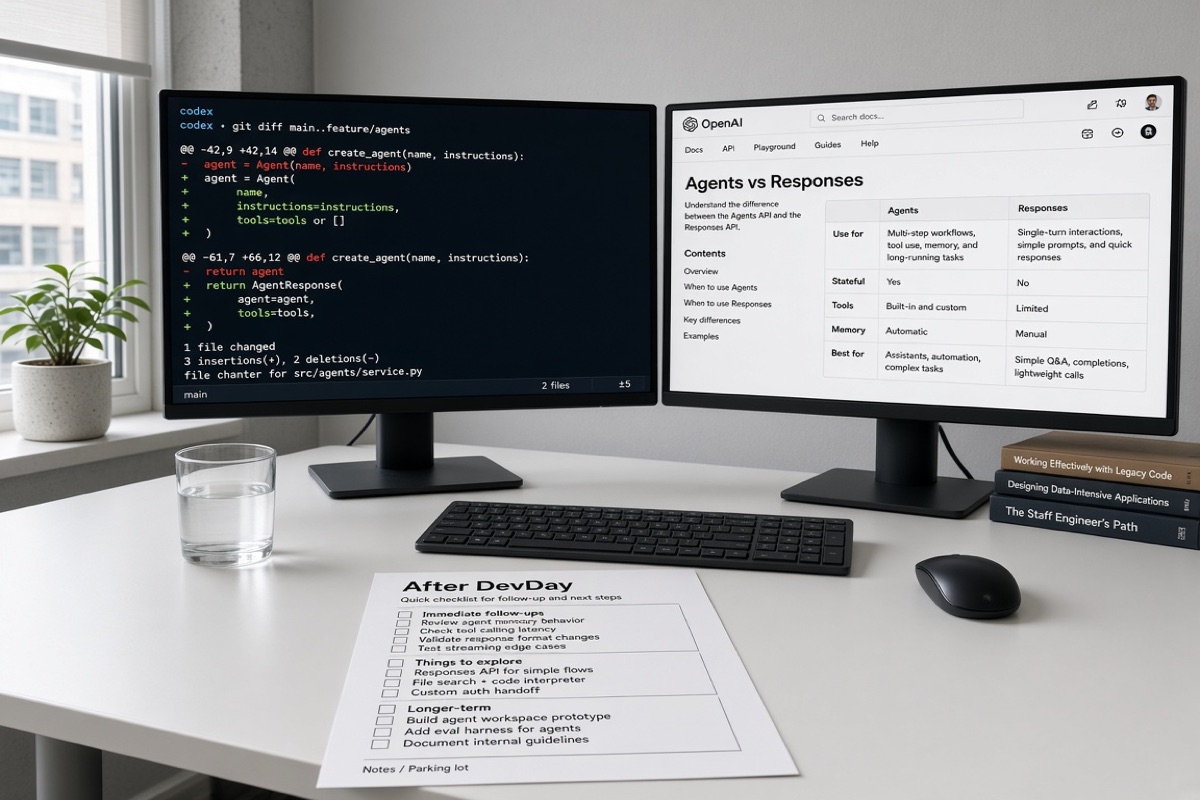
What has OpenAI already confirmed for DevDay 2026?
You can plan around the calendar, not around products that have not shipped. The DevDay site lists Tuesday, September 29, 2026 at Fort Mason in San Francisco. The opening keynote is 10:00 a.m. Pacific, with Sam Altman. In-person applications are closed; invited registration is $650. The keynote livestream is free. Other sessions land on openai.com afterward. DevDay Exchanges in Bengaluru, Tokyo, Seoul, Paris, Berlin, London, São Paulo, and Mexico City are a later tour, not the September 29 launch list.
This is for three readers: a backend owner moving off Assistants, a developer already using Codex who is unsure whether to add the Agents API, and a lead who has to say “move this / leave that” within 48 hours of the stream. Recap posts will not answer those three jobs.
What is already live and relevant:
- Agents API— public beta on September 10, 2026. OpenAI hosts the Codex harness; you pick model, tools, and environment. The announcement says there is no extra API fee—tokens, tools, and hosted containers only.
- Assistants API— shut down August 26, 2026 per the platform changelog. Do not start new work there.
- Codex— CLI, IDE extension, Cloud, and the Codex SDK are already separate surfaces.
- Pricing— model rates, web search, File Search, and containers live on the official Pricing page. Stage numbers do not count.
What do the API, Codex, Agents, and Tools each own?
These four names show up in the same search box. They are not four interchangeable plans. The official Agents guide is the map: managed harness → Agents API; loop in your app → Agents SDK; raw model I/O → Responses API; embedded chat → ChatKit. Compare runtimes
| Name you hear | What it actually owns | First job it should do |
|---|---|---|
| OpenAI API / Responses API | One request, one output; you own history and tools | Short Q&A, structured output, a loop you already wrote |
| Codex | Edits a repo: CLI, editor, Cloud, SDK | Fix a test and produce a diff on your machine or in CI |
| Agents API | Hosted Codex harness: sessions, compaction, sub-agents, resume | Multi-hour investigations with tools and a sandbox |
| Agents SDK | The loop runs in your process; you store state and approvals | State must stay in your VPC or database |
| Tools | Web search, File Search, MCP, functions, hosted shell | Attach only what this task needs |
Codex and the Agents API share a harness idea, not an entry point. Official SDK docs are blunt: coding threads use the Codex SDK; if Codex is one specialist in a larger workflow, expose it as MCP and orchestrate with the Agents SDK. Codex SDK For machine-readable tool contracts see how JSON Schema constrains tool calls. For the path from free text to MCP, see why agents moved past raw JSON calling.
When should you use Responses vs the Agents API?
Do not start with the newest model name. Ask who runs the loop, where state lives, and whether a failed run can resume.
| Job | Start here | Skip this first |
|---|---|---|
| One-shot summary, classify, extract JSON | Responses API | Agents API (you pay for session and sandbox with no gain) |
| Edit one repo and read the git diff | Codex CLI or Codex SDK | Dropping the whole monorepo into a hosted sandbox on day one |
| Work that spans hours, subtasks, resume | Agents API | Hand-rolling an overnight loop on Responses |
| Approvals, secrets, and sessions must stay in your app | Agents SDK | Default hosted sessions (Agents API is US residency only and not ZDR) |
| Embed a chat pane | ChatKit | Wrapping chat in the Agents API |
If you already bounce Claude Code, Codex, and Cursor across three base URLs, unify the gateway before you debate models. Our OmniRoute notes cover a local gateway—that does not answer “should we adopt the Agents API,” but it stops three keys from splitting the invoice. For a wider coding-agent map see the 2026 AI coding agent ranking.
How do you split token cost from tool fees?
Responses, Chat Completions, Realtime, and Batch have no separate interface fee. The Pricing page says the same for the Agents API beta: no harness surcharge. Split the month into three lines:
- Model tokens— input, cached input, cache writes, output. Long-context rows cost more. Regional processing adds 10% on eligible models released on or after March 5, 2026.
- Tool calls— web search is about $10 / 1k calls plus retrieved tokens at model input rates. File Search storage is $0.10 / GB / day (1 GB free) and $2.50 / 1k calls.
- Sandbox / containers— Hosted Shell and Code Interpreter bill by size and session, for example about $0.03 per 20-minute 1 GB session and $0.12 for 4 GB; eligible sessions bill by the minute with a 5-minute minimum.
Use standard short-context list prices from the live page (USD per 1M tokens) when you draft a budget:
| Model | Input | Cached input | Output | Best fit |
|---|---|---|---|---|
| gpt-6-astra | 10.00 | 1.00 | 50.00 | Hard jobs; default flagship in Agents examples |
| gpt-5.6-sol | 4.00 | 0.40 | 20.00 | Daily agents; promo at least through November 21, 2026 |
| gpt-5.6-terra | 2.00 | 0.20 | 12.00 | Bulk short requests |
| gpt-5.6-luna | 0.20 | 0.02 | 1.20 | High-QPS classify and route |
| gpt-5.3-codex | 1.75 | 0.175 | 14.00 | Codex / coding agents |
The same model also has Batch (about half) and Fast / Priority (higher). A “chat” with web search on is model output + $10/1k search calls + retrieved tokens. Sub-agents add their own tokens to the same job. Tool Search and programmatic tool calling exist so you do not stuff every function definition into context.
Price a single “investigate the last 30 minutes of 5xx” run instead of memorizing stickers. Say the parent agent is gpt-5.6-sol, 80k input, 6k output, four web searches, one 1 GB container for 20 minutes: about $0.44 model, $0.04 search, $0.03 container—roughly $0.50. The same job on gpt-6-astra is about $1.10 in model alone. Three parallel sub-agents each add a full pass. Cache hits and retrieved snippets move the number; replay one real invoice before you publish a forecast.
Estimate tool rounds and whether a container starts before you pick a model. Comparing input stickers alone will not match a long-running bill.
Hosted sandbox, self-hosted, or local Codex—how do you deploy?
The Agents API splits “who runs the loop” from “where code executes.” Official options: an OpenAI-hosted sandbox (same isolation family as Codex / ChatGPT), your own workspace, or a partner sandbox (the announcement lists Blaxel, Cloudflare, Daytona, DigitalOcean, E2B, Modal, Oracle, Runloop, Vercel).
| Deploy | Where the loop runs | Where files and secrets live | Use when |
|---|---|---|---|
| Local Codex CLI / SDK | Your laptop or CI | The current repo | Daily edits and diffs |
| Agents API + hosted sandbox | OpenAI | Their container | Prove a long job; skip if the repo cannot leave your network |
| Agents API + self-hosted | OpenAI runs the harness | Your workspace / VPC | You want hosted orchestration without shipping source off-disk |
| Agents SDK | Your application | Storage you choose | Approvals, audit, multi-tenant |
Docs also say the Agents API currently supports US data residency only and is not Zero Data Retention; a self-hosted sandbox does not make it ZDR. Ask about secrets, customer code, and US egress before you pick a runtime. Local Codex dies when a laptop sleeps. Long jobs, sub-agents, and resume need a machine that stays up. Wiring MCP onto a fixed node is in deploying an MCP server on a cloud Mac mini.
Do not stand up three environments on day one. Get Codex through a read-only pass and a one-function diff, with the key in process env or a locked-down file. When you need multi-hour resume, open the Agents API against an isolated directory or empty repo—not production. Move the loop into the SDK only after you can point to the approval step and the table that stores the session.
After September 29, what should you switch and what should you leave?
The first 48 hours are for verification, not a fleet cutover:
- Check that the day’s openai.com index post and Pricing moved together. If only one moved, treat it as a demo.
- Read the platform changelog: is the Agents API still public beta or GA? Beta fields and billing can still change.
- Do not rewrite a working Responses integration for a slogan. Add fields when they appear on the API you already call.
- Keep daily coding on Codex CLI / SDK unless docs say a coding model exists only on the Agents API.
- Do not grow the default tool list overnight. Run the same acceptance task in an isolated directory first.
- Add a “post-event unit price” column. Fast mode, regional uplift, and container minutes move a bill faster than a model rename.
If the current stack finishes the job, leave it. The stage will push “put everything on Agents.” Short calls stay on Responses, coding stays on Codex, long work is the only place to re-evaluate the Agents API—unless official docs retire one of those sentences.
FAQ
When is OpenAI DevDay 2026, and can I watch without a ticket?
Tuesday, September 29, 2026 at Fort Mason in San Francisco. In-person applications are closed. The opening keynote is livestreamed for free; other sessions are posted on openai.com after the event.
Does the Agents API add a platform fee?
Not during public beta. You pay model tokens, tool calls, and hosted containers. A missing Agents API line on the invoice is expected.
Are Codex and the Agents API the same product?
No. Codex is the coding surface (CLI, IDE, Cloud, SDK). The Agents API hosts the Codex harness for long-running, multi-tool work. Use Codex on a repo; use the Agents API when your backend needs a durable agent session.
Can I still call the Assistants API?
The Assistants API shut down on August 26, 2026. New work should use the Responses API for short calls and the Agents API or Agents SDK for long tasks.
Should I wait until September 29 to start?
Keep shipping on the current stack. Do not put keynote-only claims into a production cutover or a budget until they appear in official docs and the pricing page.
Long jobs and Codex sessions need a machine that stays awake
An Agents API session can resume across hours. Codex CLI and a local sandbox stop when a laptop lid closes, the machine sleeps, or the network flips. Keys, isolated directories, and MCP processes also do not belong in the same home folder as everyday browsing.
After a short local task and a first diff pass, if you need a fixed IP, snapshotable macOS node with revocable access for Codex or a self-hosted sandbox, look at a dedicated cloud Mac instead of dropping a production repo into a public-beta hosted container. See ZekVPS cloud Mac mini plans